

Predictive Maintenance
Condition Monitoring
Vibration, thermal imaging, and ultrasonic condition monitoring that catches equipment failure before it causes downtime.
Catches bearing failure before breakdown
Reduces unplanned downtime
Prioritized, quantified reports
Recognise the Problem
You've had repeated or unplanned downtime from bearing, motor, pump, or gearbox failures.
A machine feels, sounds, or runs slightly differently than usual, but nothing is visibly wrong yet.
You're relying on routine visual or audible checks alone, without vibration, thermal, or ultrasonic instruments to catch developing faults early.
Failures tend to get noticed only once they're loud or visible — by which point the damage has usually already progressed.
Here's what that looks like in practice — what we investigate, how we assess it, and what you'd typically find:
What We Inspect
Rotating equipment, motors, pumps, gearboxes, and static assemblies across your plant — tracked over time using vibration, thermal, and ultrasonic instruments.
What We Measure
Developing bearing wear, misalignment, imbalance, and looseness — often months before they would surface as an audible or visible fault.
How It Helps
Maintenance teams act on the highest-impact issues first, scheduling repairs before a failure forces an unplanned shutdown.
Our Advantage
15,000+ man-hours of in-plant detection experience and over a decade of vertical focus on condition monitoring alone.
Every failing bearing announces itself long before it fails — you just have to know how to listen. The earliest signals are never loud; they're a faint shift in vibration or a few degrees of extra heat that's easy to miss without instrumentation built specifically to catch it.
Permaweld's condition monitoring service combines vibration analysis, thermal imaging, and ultrasonic detection to track the health of rotating and static equipment over time, comparing each reading against that specific machine's own established baseline rather than a generic industry standard, so a genuinely developing fault stands out clearly from normal day-to-day operating variation.
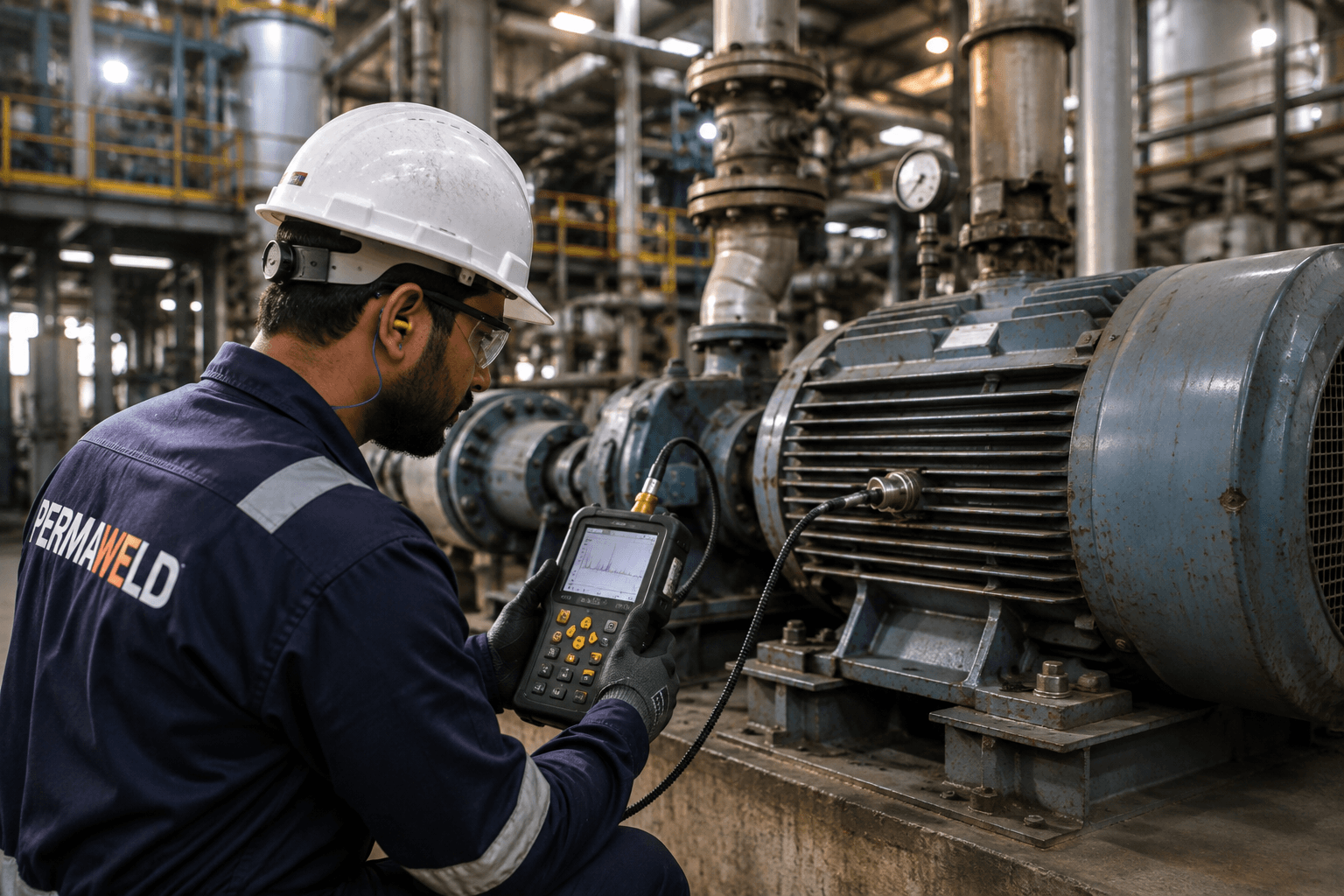
When bearings, gears, and other moving parts begin to fail, they emit ultrasound long before the damage becomes audible to the human ear. Using ultrasonic instruments, our engineers trace that early signal back to its exact source — a single bearing can be monitored for race wear by touching a probe to its housing, even close to other moving parts and ambient plant noise. This lets us isolate one developing fault from the general hum of a running plant, rather than waiting for it to become loud enough to notice on the factory floor.
Built on more than a decade of vertical focus and 15,000+ man-hours of in-plant detection experience, our engineers identify developing faults — bearing wear, misalignment, imbalance, and looseness — well before they become unplanned downtime. Each fault type has its own characteristic signature across vibration, heat, and ultrasound, and recognizing that signature reliably is what separates a genuinely predictive program from routine equipment checks.
Reports are quantified and prioritized so your maintenance team can act on the highest-impact issues first, scheduling repairs during planned downtime rather than being forced into an unplanned shutdown by whichever failure happens to announce itself loudest on a given day.
Recommended Next Step
A prioritized report of findings — developing bearing wear, misalignment, imbalance, or looseness — quantified so your team can act on the highest-impact issues first.
See a real example: Cutting bearing temperatures at a nuclear power station
Discuss My PlantWhere this service is commonly used
Related predictive maintenance services
Condition Monitoring — Frequently Asked Questions
What is condition monitoring?
Condition monitoring is an ongoing predictive maintenance technique that tracks the health of rotating and static equipment over time using vibration analysis, thermal imaging, and ultrasonic detection, catching developing faults before they cause a breakdown.
Why is condition monitoring important for industrial plants?
Failing bearings and other moving parts emit ultrasound and heat long before a failure becomes audible or visible — catching those early signals prevents unplanned downtime and lets maintenance teams schedule repairs on their own terms.
How is condition monitoring performed?
Engineers combine vibration analysis, thermal imaging, and ultrasonic detection, tracing early signals back to their exact source — a single bearing can be checked for race wear by touching a probe to its housing, even amid other moving parts and ambient plant noise.
What equipment is used?
Vibration analysis instruments, thermal imaging cameras, and ultrasonic detection probes are used to monitor rotating equipment, motors, pumps, gearboxes, and static assemblies.
Which industries use this service?
Condition monitoring is used across heavy industry and manufacturing plants with significant rotating equipment, including refineries, power generation, metals and mining, and engineering component manufacturing.
What information does the customer receive?
Findings on developing bearing wear, misalignment, imbalance, and looseness are quantified and prioritized, so the maintenance team can act on the highest-impact issues first.